

For patients
Independence and a sense of security. A therapy that supports memory and cognitive function, to help preserve what matters most.
Vguard is a non-invasive stimulator worn during sleep. Gentle impulses reach the vagus nerve through electrodes at the outer ear, while the brain consolidates memory.
The therapy is administered at night, when physiological memory consolidation takes place. No surgery and no implanted electrodes, only a headband and small electrodes at the ear.
Used every night, taking advantage of the period when the brain consolidates and organises information.
Developed from years of research into hippocampal theta rhythm, a mechanism associated with learning and memory.
Stimulation protocols are tuned to REM sleep and other stages in which memory consolidation is most active.
A therapeutic system of a neurostimulation device, specially designed ear electrodes and software that supports correct use. Designed for regular, long-term use as recommended by the physician.
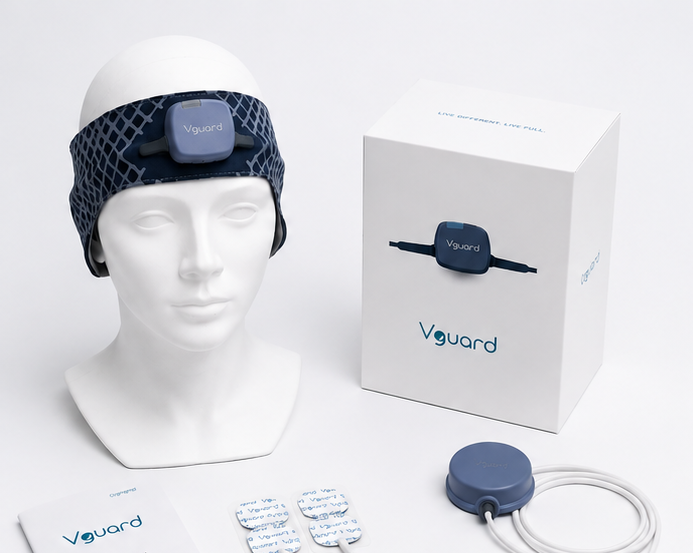
Electrodes sit on a specific area of the outer ear. Nothing is implanted.
Each session is optimised for safety, comfort and therapeutic value.
A doctor decides whether therapy can begin and follows its use.
Over a decade of research and development behind the technology.
Electrodes at the outer ear reach the auricular branch of the vagus nerve, so the therapy needs no surgery and no implant.
Gentle impulses are delivered through electrodes positioned on the auricular branch of the vagus nerve.
The signal travels through structures in the brainstem along vagus nerve pathways.
It modulates neural networks involved in attention, learning and memory, including hippocampal activity.
Vagus nerve stimulation has been used clinically in neurology and psychiatry for more than 25 years, including in epilepsy and treatment-resistant depression.
Independence and a sense of security. A therapy that supports memory and cognitive function, to help preserve what matters most.
Technology designed to reduce the time and financial burden of care, so families can focus on staying close.
Solutions that can help reduce the burden on caregivers, limit costs and meet growing demand.
Preclinical and neurophysiological studies showed the effect of vagus nerve stimulation on type II theta rhythm in the hippocampus. Development continued with a randomised, double-blind, placebo-controlled medical experiment.
PLOS ONE, 2018
Broncel A., Bocian R., Kłos-Wojtczak P., Konopacki J.
Brain Research Bulletin, 2018
Broncel A., Bocian R., Kłos-Wojtczak P., Konopacki J.
2019
Broncel A., Bocian R., Kłos-Wojtczak P., Kulbat-Warycha K., Konopacki J.

“The opportunity to turn scientific innovation into real solutions for devastating conditions like Alzheimer's. Knowing that our work can change patients' lives gives me purpose every single day.”
Adam Broncel, MD, PhD · Chief Medical Officer, led the first human trials of the Vguard method
Vguard is intended for Alzheimer's disease and mild cognitive impairment, in line with its intended purpose. A physician decides whether a patient qualifies.
No. Electrodes are placed on a specific area of the outer ear. No stimulating component is implanted.
Sleep is when memory consolidation and organisation take place, and the protocols are tuned to the sleep stages where this is most active.
PLN 22,000 for one year, including the device, daily disposable electrode sets for 12 months and technical support.
Vguard is a Class IIa medical device, CE marked under Regulation (EU) 2017/745, with conformity assessment by TÜV Rheinland LGA Products GmbH (NB 0197).
Leave your details and we will explain the organisational steps toward medical qualification.
Express interestClinical and scientific questions, and collaboration on upcoming studies.
Write to our medical teamJoin us in advancing Alzheimer's care, in Europe and beyond.
Contact the CEO office